
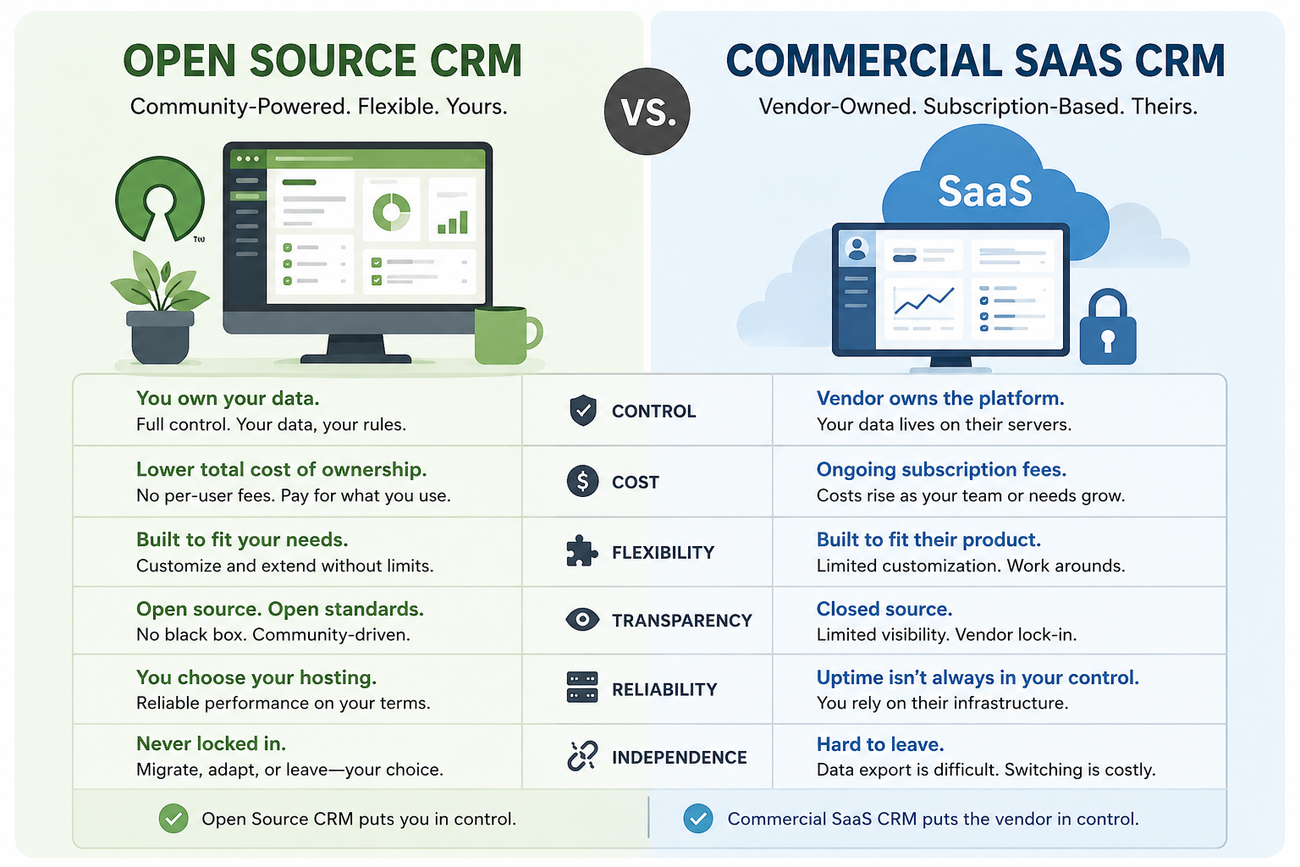
When a nonprofit starts looking for a CRM, two names often come up early: CiviCRM and Salesforce for nonprofits.
These are both capable systems. Each helps you to manage contacts, donors, activities, campaigns, email lists, events, and reports. Either can be extended and customized. And, in the wrong setting, either one can become expensive, confusing, or frustrating.
So how should you choose?
The real question is whether your nonprofit needs an open source tool that you control, or a large commercial platform with a major vendor ecosystem behind it.
Quick Answer
The quick answer is choose CiviCRM if you want an open source CRM built specifically for NPOs. Choose it if you want control over your hosting and data, need a close fit with Drupal or WordPress, and want to avoid per-user software license fees.
Choose Salesforce if you want a large commercial CRM ecosystem, have the budget for implementation and ongoing administration, and expect to rely on Salesforce consultants, Salesforce apps, and the broader Salesforce platform.
For many small and mid-sized nonprofits, CiviCRM is often the more practical choice. For larger organizations with internal Salesforce administrators and a serious implementation budget, Salesforce may be the better fit.
What Is CiviCRM?
CiviCRM is an open source Constituent Relationship Management system built for nonprofits, associations, advocacy groups, civic organizations, and similar groups.
It includes tools for managing contacts, donations, memberships, event registration, email campaigns, activities, reports, cases, grants, and campaigns. It can run inside of WordPress, Drupal, Joomla, Backdrop, or as a standalone system.
The important thing to understand is that CiviCRM is not a sales CRM that nonprofits adapted for their needs. It was built around the nonprofit and civic-sector work from the start.
What Is Salesforce for Nonprofits?
Salesforce is a large commercial CRM platform used by businesses, universities, healthcare organizations, government agencies, nonprofits and many other organizations.
For nonprofits, Salesforce offers nonprofit-specific products and discounts. Eligible organizations may qualify for free or discounted licenses, and there is a large network of consultants, apps, training programs, and implementation partners available.
Salesforce is powerful, but it is also a platform. Choosing it is not only a question of “which CRM should we use?” It is also a decision to build your CRM processes around the Salesforce way of doing things.
Cost: Free Software Is Not the Same as Free CRM
CiviCRM is open source software. There is no fee to download and use it, indefinitely.
That does not mean a serious CiviCRM system costs nothing. You still need hosting. For some folks, however, that’s sufficient. For others, they do need professional assistance with setup, customization, security updates, backups, configuration, training, and occasional support.
Salesforce usually starts from a different place. The software is commercial, although nonprofits may receive discounted or free starter licenses. As the organization grows, the long-term cost can include more licenses, add-ons, consulting, data migration, custom configuration, training, and ongoing administration.
The trap is not usually the first month’s cost. It is the cost after the system becomes important: new fields, staff permissions, reports, integrations, imports, email issues, and someone needing to know why the numbers do not match. That ongoing ownership is where many CRM decisions succeed or fail.
In plain English:
- CiviCRM saves money on software licenses, but it still needs competent hosting and may need paid support.
- Salesforce removes most hosting responsibility, but license, consulting, and administration costs can add up.
For a nonprofit with five users, Salesforce may look inexpensive at first. For a nonprofit with 50 or more users, the license math can look very different. CiviCRM does not charge more simply because you add more staff accounts.
Hosting and Data Control
This is one of the biggest differences between the two systems.
With CiviCRM, you choose where the system runs. You can host it with a specialist hosting provider, on your own server, or with any general qualified host. You are not locked into one vendor’s cloud platform.
That flexibility comes with responsibility. CiviCRM needs a proper server environment, including the correct server software versions, plus server security and support.
Salesforce is cloud software, and that can be a major advantage for organizations that do not want to think about hosting at all. The tradeoff is that you operate inside Salesforce’s ecosystem, with Salesforce’s architecture, pricing, tools, and rules.
If your organization values data portability and open source control, CiviCRM has a clear advantage. If your organization just wants a fully vendor-managed cloud platform, Salesforce has an advantage.
Ease of Use
Neither system is magic.
Salesforce often looks polished, but a serious nonprofit Salesforce setup will still require a lot of configuration. Staff may need training on objects, reports, dashboards, campaigns, contacts, households, opportunities, and nonprofit-specific workflows.
CiviCRM can also feel complex at first. It has many screens, many configuration options, and many nonprofit-specific tools. But after a bit of introduction, it can also be used very simply to just manage your list(s) of contacts and donors etc.
The real question is not which system feels easier on day one. The question is which system your staff can use effectively on an ongoing basis, once the real work begins.
Website Integration
CiviCRM is especially strong when you want integration into your website.
For example, with CiviCRM you can handle:
- Donation forms
- Membership signup forms
- Event registration
- Contact forms
- Public profile pages
- Member-only content
- Drupal or WordPress user integration
- Automated email confirmations
directly in your website. That means that CiviCRM can feel like a natural extension of the site. That’s one reason many organizations choose it.
Salesforce can also integrate with websites, but the model is different. You may use Salesforce forms, third-party form tools, API integrations, middleware, or custom development. That can work very well, but it is not always simple or inexpensive.
Customization
Both systems can be customized, but they are customized in different ways.
CiviCRM can be adapted through extensions, custom fields, profiles, scheduled jobs, API calls, CMS integration, and code-level development. Because it is open source, a qualified developer can inspect how the system works and modify it where appropriate.
Salesforce can be customized through its platform tools, automation, flows, objects, fields, Apex code, AppExchange apps, and consulting ecosystem. The platform is extremely powerful, but Salesforce customization is its own specialty.
This is where internal skills matter. If your organization already has Salesforce staff or Salesforce consultants, Salesforce may be easier to maintain. If your organization already works with PHP, Drupal, WordPress, or open source providers, CiviCRM may fit more naturally.
Feature Comparison
| Area | CiviCRM | Salesforce for Nonprofits |
|---|---|---|
| Software model | Open source | Commercial cloud platform |
| License cost | No per-user software license fee | Discounted/free nonprofit options may be available, but paid licenses are common as needs grow |
| Hosting | You choose the host | Hosted by Salesforce |
| Best website fit | Drupal, WordPress, Joomla, Backdrop, standalone | Integrates through Salesforce tools, apps, forms, and APIs |
| Donations | Built for nonprofit contributions | Strong nonprofit fundraising tools available |
| Events | CiviEvent included | Usually handled through Salesforce configuration or third-party tools |
| Memberships | CiviMember included | Possible, but depends on implementation |
| Email campaigns | CiviMail available | Strong options, often through Salesforce products or integrations |
| Data ownership | High control | Controlled inside Salesforce platform |
| Implementation ecosystem | Smaller specialist ecosystem | Very large consultant and app ecosystem |
When CiviCRM Is the Better Choice
CiviCRM is often the better choice when:
- You want an open source CRM.
- You do not want per-user CRM license costs.
- You want control over your hosting and data.
- Your website is built in WordPress or Drupal.
- You need donations, events, memberships, and email lists in one system.
- You have access to CiviCRM hosting or CiviCRM technical support.
- You prefer practical nonprofit tools over a large commercial platform.
CiviCRM is not perfect. It needs proper maintenance. Updates matter. Email deliverability matters. Backups matter. Server performance matters. But with the right setup, it can be a strong long-term system without locking you into per-user CRM licensing.
When Salesforce Is the Better Choice
Salesforce may be the better choice when:
- Your organization already uses Salesforce.
- You have staff who know Salesforce administration.
- You need a large commercial CRM ecosystem.
- You expect to use many Salesforce apps and integrations.
- You have budget for implementation and ongoing consulting.
- Your CRM needs go far beyond standard nonprofit contact, donation, event, and membership workflows.
Salesforce can be an excellent system. The mistake is assuming that a large platform is automatically easier. For many nonprofits, Salesforce works well only when the organization has the budget and staff discipline to manage it properly.
The Hidden Issue: Who Will Maintain It?
This is the question that gets skipped too often.
Every CRM needs an owner. Someone has to answer practical questions like:
- Who adds new fields?
- Who cleans duplicate contacts?
- Who checks failed emails?
- Who handles staff permissions?
- Who updates donation forms?
- Who fixes reports when they stop making sense?
- Who handles backups, upgrades, and security?
With CiviCRM, that person may be your host, your developer, your internal technical person, or a CiviCRM consultant.
With Salesforce, it may be your Salesforce admin, your consultant, or an internal operations person trained on Salesforce.
Either way, the CRM will not maintain itself.
Conclusion
CiviCRM and Salesforce can both serve nonprofits well, but they come from different worlds.
If your nonprofit wants an open source CRM that can be hosted, secured, backed up, and supported by specialists, CiviCRM is a serious option. If your nonprofit wants to build around the Salesforce platform and has the budget to support that choice, Salesforce may be the better fit.
Need CiviCRM Hosting or Setup Help?
CiviHosting provides expert CiviCRM hosting, including fresh installs, secure hosting, backups, updates, and migration from another host.
If you are ready to start with a fresh CiviCRM install, you can also view our hosting plans. If you already know you want CiviCRM, we can help you get it running correctly from the start.
About the Author
If your nonprofit is comparing CiviCRM options, we can also review your current or planned hosting setup. See our free CiviCRM hosting review and our CiviCRM official partner page.